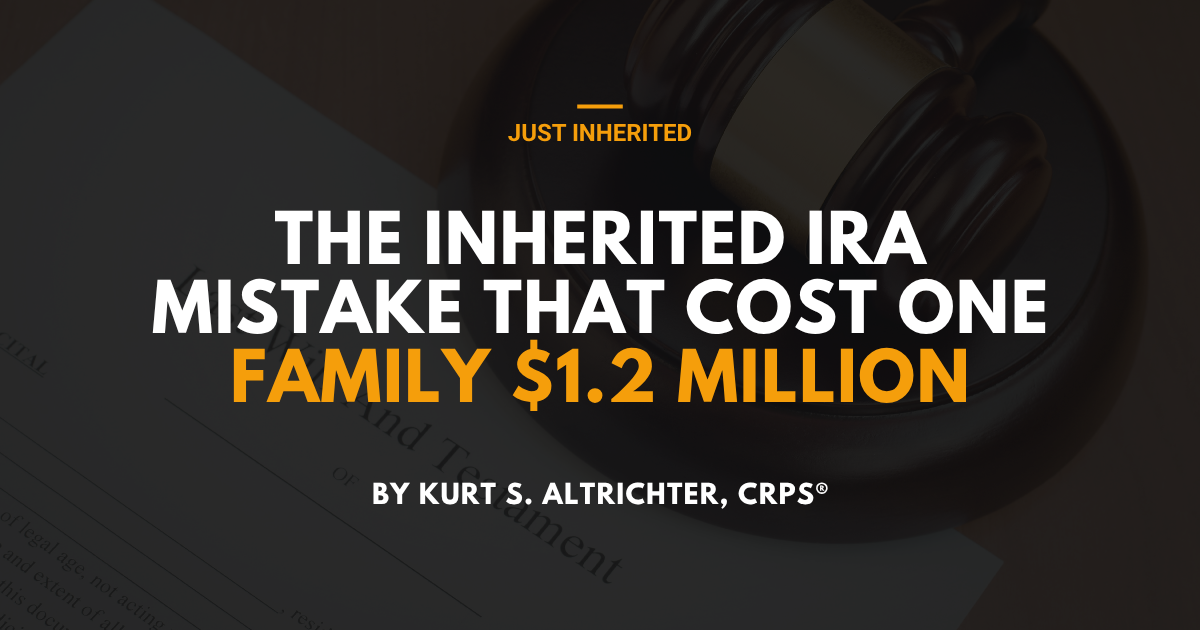
The Inherited IRA Mistake That Cost One Family $1.2 Million: How One Sibling's Financial Desperation Destroyed Three Inheritances

I have been overseeing finances for people in major life transitions for over a decade. I have seen inheritances handled well and inheritances handled terribly. Katie's story is one of the worst. Sadly, it is very common.
Katie did not call me until months after the damage was done. By then, it was too late to fix. If she had called me in the first 90 days, we could have prevented a $1.2 million tax catastrophe.
Here is what I want you to understand: if someone you love dies and leaves you an inheritance, do not make any decisions for at least 90 days. Assemble your fiduciary team first. Then move.
The 90-day rule Katie never followed
When a parent dies with retirement accounts (401(k)s, IRAs, SEP-IRAs), the beneficiaries and executor face immediate pressure to act. The custodian calls asking for instructions. The executor wants to settle the estate quickly. A desperate sibling pressures for immediate liquidation.
Do not listen. Do not act. Everyone needs to calm down. Death is not a financial emergency that requires a decision within days. Everyone can wait it out.
Those 90 days exist for four reasons:
First, you need time to grieve. Death is not a financial transaction. Second, you need to assemble a professional team: a CPA who understands inherited IRAs, an estate attorney, and a fee-only financial advisor. Budget $3,000 to $8,000. This is the best money you will ever spend. Third, you need to understand your options. Most people do not know the difference between liquidating an IRA and splitting an inherited IRA into separate accounts. Fourth, if you are inheriting with siblings, you need time to protect against one person's financial crisis overriding everyone else's interests.
Katie had none of these things. She was grieving. She did not have a professional team. She did not know the rules. And her oldest brother, Brandon, was actively bullying her into not getting involved, telling her that all financial advisors are salesmen.
The executor made a decision in days, not months. Katie found out what happened after the fact.
How Brandon created the crisis
Katie's mother died after a long battle with cancer. Among other assets, she left a $3 million pre-tax IRA to be split equally among three adult children: Katie, her stable middle brother Alex, and her oldest brother Brandon.
Brandon had sunk everything into his failing med-tech startup. He had maxed credit cards, taken family loans, and put a second mortgage on his house. This did not stop him from taking his family on two nice vacations that year. When his mother died, he saw a $1 million lifeline.
He did not want to wait. He did not want his siblings consulting with a CPA. He repeatedly told Katie that all financial advisors are salesmen trying to take her money. He wanted the entire $3 million liquidated immediately so he could access his share. He pressured the executor relentlessly. "Uncle, my startup is almost there. Just liquidate the account and split it three ways. It is simple."
Katie was grieving. Alex wanted to avoid family drama. The executor, uncomfortable with conflict and lacking expert guidance, caved to Brandon's pressure.
The executor liquidated the entire $3 million account in days.
What that decision cost them
The correct approach: Split the $3 million into three separate inherited IRAs, one for each sibling. Each person controls their own money. Under SECURE Act 2.0 rules, each sibling has 10 years to fully distribute their $1 million inherited IRA. In those 10 years, the money grows tax-free. Taxes are owed only on amounts actually withdrawn.
Katie's scenario, done correctly:
- Inherited IRA balance: $1,000,000
- If she withdrew $100,000 per year for 10 years: $1,000,000 in total distributions
- Her income each year (from job plus distribution): roughly $140,000
- Taxes on that income (approximately 34% combined federal plus Minnesota state): roughly $34,000 per year
- Net after-tax proceeds over 10 years: approximately $660,000
- Plus growth: The money left invested grows at roughly 6% per year, compounding to approximately $1.79 million over the decade. She can take smaller distributions in later years or let more grow.
Katie would have had control. Katie would have had flexibility. Katie would have preserved her inheritance.
What actually happened
The executor liquidated the $3 million immediately and distributed the proceeds to the three siblings.
Here is the critical part that most people do not understand: Katie did not receive the cash first and then get billed for taxes later. Instead, the IRS treated the $1 million distribution as taxable income to Katie in that single tax year. That means the full $1 million is subject to federal income tax (37% at the top bracket) plus Minnesota state income tax (9.85%).
Katie's tax bill for that $1 million in additional income was approximately $468,000 (37% federal plus 9.85% state equals 46.85%).
Here is what happened to Katie in practical terms:
She received one check from the executor for $1,000,000. That was her share of her mother's IRA.
She owed the IRS $468,000 in taxes on that $1 million distribution, payable in the following year when she filed her tax return.
She paid the $468,000 tax bill from the $1 million she received, leaving her with approximately $532,000.
Her inheritance was cut in half.
Across all three siblings, the family paid $1.2 million in unnecessary taxes. This was not because of bad luck. This was because one brother's financial desperation led him to pressure the executor into liquidating an IRA instead of splitting it, creating an immediate $1.2 million tax liability.
Katie, at 22 years old, expected to inherit $1 million. She received $1 million in cash but owed $468,000 in taxes. After paying the bill, her net inheritance was $532,000. Half of what she should have had.
When Katie finally called me
Katie reached out months later, confused and upset. She had received a $1 million check but owed nearly $500,000 in taxes. She could not understand how that was legal or why no one had warned her.
I explained what had happened: the executor should have split the IRA into three separate inherited accounts. The entire distribution should never have been liquidated. The 90-day waiting period should have been observed.
Katie said: "I did not know we had options. I was grieving, and my brother told me all financial advisors are salesmen. I did not know to call you."
This is the moment I understood: most people do not know the 90-day rule. Most families make these decisions in panic. Most executors do not consult professionals. And by the time someone calls a fiduciary advisor, it is too late.
Why the 90-day rule matters
You cannot undo an inherited IRA liquidation. Once the money is distributed as a lump sum, it is taxable income. You cannot claim it was a mistake. You cannot reverse it. The tax bill is permanent.
But if you wait 90 days and consult professionals before any moves are made, you have real options: split the IRA into separate inherited accounts, manage distribution timing for tax efficiency, protect against pressure from one sibling's financial crisis, and document your decisions for the record.
A 90-day delay costs nothing. A liquidation mistake costs hundreds of thousands of dollars.
What to do if someone you love dies
If a parent or grandparent dies and leaves you retirement accounts:
Days 1-7: Grieve. Handle the funeral. Tell the executor: "I need 90 days before you make any distribution decisions on retirement accounts."
Days 8-30: Call a CPA who specializes in the assets you are inheriting. Call an estate attorney. Call a fee-only financial advisor. Have consultations with all three. Total cost: $3,000 to $8,000. This is the best money you will spend.
Days 31-90: Your professionals tell you what the law allows, what your rights are, and how to structure this for long-term security. You decide together: split the inherited IRA or take a distribution? If split, what is your 10-year distribution strategy?
Day 91 and beyond: The executor makes the distribution decision based on professional guidance, not panic. You have a documented plan. Your siblings are protected from one person's financial emergency overriding everyone's interests.
What to tell the executor
If you are a beneficiary: "I need 90 days before you make any distribution decisions on retirement accounts. I am assembling a fiduciary team to ensure this is handled correctly. A $3 million mistake costs more than 90 days of waiting."
If you are the executor and a beneficiary is pressuring you: "I understand you need cash. But I have a fiduciary duty to all beneficiaries, not just to you. I am consulting with a CPA before I make any retirement account distribution decisions. This will take 90 days." Be very direct. You are in control.
Katie's life now
Katie paid the tax bill. She went to college. She built a career. But she never forgot that her inheritance was cut in half because her brother's desperation overrode what was best for her financial future.
If Katie had followed the 90-day rule, she would have $1 million in an inherited IRA today, with control over the next decade of distributions. Instead, she has $532,000 in the bank and a permanent reminder that grief, panic, and family pressure create expensive mistakes.
About me
I am Kurt Altrichter, CRPS, founder and Chief Investment Officer of Ivory Hill, LLC. I work with individuals and families navigating major financial transitions: inheritances, business exits, sudden wealth, retirement planning.
I have personally guided clients like Katie through the aftermath of inherited IRA mistakes. I have also helped hundreds of other families avoid these mistakes by calling me in the first 90 days.
If someone you love has recently died and left you retirement accounts, call me now. Do not wait for the executor to pressure you. Do not let a sibling's financial crisis override what is best for your future.
Schedule a consultation: Book a time that works for you [LINK]. We can discuss your situation and create a plan within the first 90 days.
You can also reach me at kurt@ivoryhill.com or visit ivoryhill.com.
Disclosure
The information provided in this article is for educational purposes only and should not be construed as personalized investment, tax, or legal advice. Names and identifying details have been changed to protect client privacy.
Inherited IRA rules are complex and depend on individual circumstances. The 90-day waiting period is a planning recommendation, not a legal requirement, but it gives you time to assemble professional guidance before making irreversible decisions.
Consult with a qualified CPA, estate attorney, and fee-only financial advisor before making any distribution decisions on inherited retirement accounts.
Ivory Hill, LLC is a registered investment adviser. Investment Adviser Representative services offered through Life Inc. Retirement Services.
Last verified: April 26, 2026 against IRC Section 401(a)(9)(H) (SECURE 2.0 Act), IRS Publication 590-B (Distributions from Individual Retirement Arrangements)